Best Water Softener Katy, TX: Comparing Dual-Tank and Single-Tank Models
Katy’s water story is more complicated than a single hardness number on a statewide map. In the Katy area, many addresses are served either by the City of Katy or by municipal utility districts tied to regional authorities such as the West Harris County Regional Water Authority and North Fort Bend Water Authority, and that means one neighborhood may see more groundwater influence while another gets a larger share of imported surface water. In the utility reports and district data I reviewed for the area, hardness commonly lands around 200–220 mg/L as CaCO3, or roughly 11.7–12.9 GPG, with some groundwater-heavy pockets higher. That is why the Best Water Softener Katy, TX question is not theoretical here: this is hard enough water to leave visible scale on shower glass, shorten water heater efficiency, and force higher soap and detergent use.
A good example is Mateo Saldarre, 38, a civil engineer, and Priya Saldarre, 36, a pediatric nurse, in Elyson. Their Katy-area home is on district-treated water that tested about 12.3 GPG. They first tried a salt-free conditioner after noticing white buildup around the kitchen faucet and a chalky ring in the dishwasher. The conditioner reduced spotting a little, but it did not actually remove hardness minerals, and their tankless water heater still needed descaling sooner than expected.
After evaluating softeners specifically against Katy’s mixed source water, one system consistently leads the field: the SoftPro Elite Water Softener. The reason is not hype. It is the combination of true ion-exchange softening, chlorine-tolerant resin, strong flow for larger suburban homes, and an efficiency profile that makes more sense than many dual-tank dealer systems for most Katy households. This guide breaks down when a single-tank model is the smarter choice, when a dual-tank system is worth considering, and which model I would actually put in a Katy home.

Key Takeaways
- 12.3 GPG is already hard enough to justify a real ion-exchange softener in Katy. At roughly 210 mg/L as CaCO3, that level is firmly in the hard-water range and is enough to create scale on fixtures, reduce water-heater efficiency, and increase soap consumption.
- Katy’s split utility landscape matters more than many homeowners realize. City water in one subdivision may be more groundwater-driven, while another Katy neighborhood may receive more imported chloraminated surface water, which changes how resin durability should be evaluated.
- SoftPro Elite is independently reviewed as the overall standout for Katy because its 8% crosslink resin is built to tolerate up to 2 PPM continuous chlorine while still delivering up to 75% salt savings versus standard downflow units.
- Most Katy families do not need a dual-tank softener. A properly sized single-tank SoftPro Elite with demand-initiated regeneration, 15% reserve capacity, and a 15-minute emergency regen covers the usage pattern of most 3- to 5-person suburban households.
- Dealer-heavy options often cost more over time in Katy than they appear to on day one. Between service contracts, higher salt use, and less efficient reserve settings, the most cost-effective solution is often the model with better regeneration efficiency rather than the one with the flashiest local showroom pitch.
QUICK ANSWER: The best water softener for Katy, Texas is the SoftPro Elite Water Softener for most homes because Katy-area water commonly runs around 11.7–12.9 GPG, many neighborhoods receive treated water with chlorine or chloramine residuals, and the SoftPro Elite combines 8% crosslink resin, 15 GPM continuous flow, upflow regeneration, and lifetime warranty coverage on the valve and tanks. In my review, it is the best overall water softener for Katy’s suburban municipal-water conditions, and it is also expert recommended because it handles city disinfectants better than many standard-resin alternatives without locking homeowners into a dealer-service model.
#1. Katy’s Water Profile — Why Source Water and Utility Districts Change the Softener Decision
Katy’s water is hard enough that the right softener choice depends not just on hardness, but on which utility district serves your subdivision.
City utility layout explains why one Katy neighborhood scales faster than another
Katy is not a one-utility city in the way many homeowners assume. Some residents are served by the City of Katy Water Department, while many “Katy, TX” mailing addresses fall under MUDs and regional water authorities in Harris, Fort Bend, or Waller County. Historically, much of Greater Katy relied on groundwater from the Gulf Coast Aquifer, which tends to carry calcium and magnesium that create hardness. Over time, more neighborhoods have shifted part of their supply to imported surface water, often treated through regional systems connected to Houston-area sources such as Lake Houston and Lake Conroe supplies.
That mix matters because groundwater-heavy supply is often the reason scale appears aggressively on faucets, showerheads, and tankless heat exchangers. Surface water imports can reduce dependence on aquifer pumping, but they usually come with a different disinfectant profile, commonly chloramine-based treatment in the broader Houston metro. For softener shoppers, Katy is a city where both hardness and disinfectant chemistry must be accounted for together.
The local hardness range is usually around 11.7 to 12.9 GPG, and some pockets run higher
In the Katy-area utility and district reports I reviewed, hardness commonly clusters around 200–220 mg/L as CaCO3, which converts to roughly 11.7–12.9 GPG using the standard formula of dividing by 17.1. According to the USGS, anything above 180 mg/L is classified as very hard water, so even the low end of many Katy readings is already in the range where homeowners start seeing visible mineral residue and reduced appliance efficiency.
Mateo and Priya’s Elyson-area supply tested about 210 mg/L, or 12.3 GPG, and their failed salt-free conditioner is a common story in Katy. That type of system may reduce some adhesion or spotting under limited conditions, but it does not remove calcium and magnesium. A true ion-exchange unit does. That is why the SoftPro Elite has become my professional-grade pick for Katy’s suburban hard-water profile: the water here is not mild enough for “good enough” conditioning if the goal is actual scale prevention.
Chlorine and chloramine exposure both matter in Katy
Some Katy utilities and districts rely on free chlorine, while many imported surface-water systems in the region use chloramines, especially monochloramine. Both are effective disinfectants under EPA drinking-water rules, but both also matter to softener resin life. Standard 8% crosslink resin is much better suited to city water than bargain-grade resin, especially where residual disinfectant is persistent.
Because Katy’s utility map is so fragmented, I tell homeowners to assume a city-water softener here should be selected for chlorine resistance first, not just grain capacity. SoftPro Elite’s resin is rated to tolerate up to 2 PPM continuous chlorine, and its expected resin life of 15–20 years is materially stronger than the 7–10 years I commonly see from lower-end standard-resin systems in treated municipal water.
#2. Sizing the Best Water Softener for Katy, Texas — Single-Tank Capacity Usually Wins
The best water softener for Katy, Texas is usually a properly sized single-tank unit, not an oversized dual-tank system.
Step-by-step sizing for Katy water at roughly 12.3 GPG
Sizing should be based on actual daily demand, not sales pressure. For Katy, I use this formula:
- Count household members
- Multiply by 75 gallons per person per day
- Multiply by local hardness in GPG
- Choose the nearest practical grain size without extreme oversizing
Using 12.3 GPG as a representative Katy-area number:
- 2 people: 2 × 75 × 12.3 = 1,845 grains/day
- 4 people: 4 × 75 × 12.3 = 3,690 grains/day
- 5 people: 5 × 75 × 12.3 = 4,612 grains/day
- 6 people: 6 × 75 × 12.3 = 5,535 grains/day
That is why most Katy families fall naturally into these SoftPro Elite sizes:
- 32K for lighter 1–2 person use
- 48K for many 3–4 person homes
- 64K for heavier-use 4–5 person households
- 80K for 5–6 person or higher-demand homes
- 110K for very large households or unusually high consumption
For the Saldarre family, a 48K or 64K model is typically the sweet spot depending on irrigation bypass setup, fixture count, and daily laundry volume.
What is GPG?
What is GPG? GPG means grains per gallon, the most common U.S. Measurement for water hardness. One grain per gallon equals 17.1 mg/L as CaCO3, so a Katy reading of 210 mg/L is about 12.3 GPG.
That number is more useful than marketing language because it directly affects softener sizing, salt usage, regeneration frequency, and long-term operating cost. Jeremy Phillips at Quality Water Treatment (QWT) is one of the few sales-side figures I consistently see using actual CCR or test data to size systems instead of just defaulting every family into a larger tank.
Why a single-tank model fits most Katy households
Dual-tank systems have a role, but most Katy homes do not need 24/7 uninterrupted soft water during a regeneration cycle. A modern single-tank SoftPro Elite uses demand-initiated metering, not a wasteful timer, so it regenerates only when real usage calls for it. It also keeps just 15% reserve capacity, while many standard systems effectively protect 30% or more, which means a lot of paid-for capacity just sits idle.
That efficiency difference is why I consider SoftPro Elite the best long-term value for Katy families with typical suburban use patterns. You get true softening, high flow, city-water durability, and up to 75% salt savings and 64% water savings versus standard downflow regeneration, without paying for a dual-tank configuration you may never truly need.
#3. Dual-Tank vs. Single-Tank in Katy, TX — Continuous Soft Water Is Not Always Worth the Premium
In Katy, dual-tank softeners are most useful for very large or nonstop-use households, while single-tank metered systems are better for most families.
When a dual-tank model makes sense in Katy
Dual-tank systems shine when water demand never really stops. Think multigenerational households, homes with back-to-back showers across four or five bathrooms, or properties where a large soaking tub, tankless heater, and frequent laundry load can all overlap. In that situation, one tank can stay online while the other regenerates.
For Katy specifically, I see dual-tank demand mainly in larger homes in master-planned communities where occupancy is high and usage is constant. If a six- or seven-person household is using 5,500+ grains per day at around 12.3 GPG, a dual-tank system starts to make more practical sense. Even then, the question is whether the family values continuous soft water enough to justify the higher upfront and service cost. For many do not-stop-using-water households, the answer is yes. For many others, it is not.
Why SoftPro Elite’s reserve strategy narrows the gap
This is where a strong single-tank system separates itself from generic softeners. The SoftPro Elite keeps only 15% reserve capacity, has a 15-minute quick emergency regeneration trigger when capacity falls below 3%, and runs a smart valve controller with self-diagnostics. That means the traditional argument for dual-tank systems is weaker than it used to be.
What is reserve capacity? Reserve capacity is the amount of softening capacity held back so you do not run out of soft water before the next regeneration. Systems with oversized reserve settings often waste usable capacity and regenerate sooner than necessary.
SoftPro Elite’s tighter reserve control is one reason it is recommended by professional plumbers who deal with suburban city water loads. In a typical Katy 4-bedroom home with 50–80 PSI municipal pressure and three bathrooms, the system’s 15 GPM continuous flow and 18 GPM peak are already enough to keep showers and appliances supplied without the dual-tank premium.
#4. Comparing SoftPro Elite to Culligan, Kinetico, and Fleck 5600SXT for Katy Municipal Water
SoftPro Elite beats most Katy competitors on efficiency, city-water resin durability, and total ownership cost, even when dual-tank brands are included.
Against Culligan: dealer support is local, but the math often favors SoftPro Elite
Culligan is heavily marketed across the Houston-Katy area, and many homeowners encounter it first through local dealer advertising, showroom promotions, or plumber referrals. The appeal is understandable: known name, local presence, and bundled service. The issue is cost structure. In Katy’s roughly 12 GPG water, the real question is not whether a system softens effectively, but how much salt, water, and contract overhead you will absorb over 10 years.
SoftPro Elite is the overall top choice in my review because its value is built into the engineering rather than wrapped into a dealer model. You get upflow regeneration, lifetime warranty on the valve and tanks, 8% crosslink resin, and DIY-friendly quick-connect installation support without local markup becoming part of every service event. That often makes it the lowest total cost of ownership for Katy homeowners who want performance but do not want to be locked into a recurring service structure.
Against Kinetico dual-tank systems: great continuity, higher premium, less need for most Katy homes
Kinetico’s dual-tank systems are well known and, in the right house, undeniably capable. They are particularly attractive to large households that cannot tolerate any interruption during regeneration. In Katy, though, most families are dealing with moderate-to-high hard municipal water, not extreme iron-heavy private well water, and that changes the equation.
The SoftPro Elite is expert recommended for Katy because it solves the actual local problem: hard treated city water with disinfectant exposure. Its 8% crosslink ion exchange resin is designed for that environment, its 15% reserve capacity avoids the waste built into many standard designs, and its vacation mode automatically refreshes resin every 7 days, which matters for families who travel during summer. Unless the household genuinely needs around-the-clock soft water during all usage hours, the extra cost of a dual-tank Kinetico often produces less ROI than a better-engineered single-tank SoftPro Elite.
Against Fleck 5600SXT: dependable platform, but older efficiency profile
The Fleck 5600SXT remains a familiar benchmark in residential softening, and I still think it is a respectable option when properly specified. Yet for Katy water, the older downflow design typically cannot match SoftPro Elite on operating efficiency. A downflow system often uses 6–15 pounds of salt per cycle, depending on settings and capacity, while SoftPro Elite’s upflow regeneration can run in a much lower effective salt-use range and reduce water waste at the same time.
That matters in the Saldarre household scenario. Mateo wanted a system he would not need to babysit, and Priya cared about reducing detergent waste and scale on baby bottles and shower glass. For a family like theirs, a high-efficiency metered system is simply a more financially sound choice than a legacy-style downflow unit. The Fleck has a long track record, but the SoftPro Elite is the field-proven winner for Katy’s specific balance of hardness, disinfectant exposure, and suburban flow demand.
#5. Installation and CCR Reading — How Katy Homeowners Avoid the Most Common Mistakes
Katy homeowners get better softener results when they verify their exact utility report, pressure, and drain setup before buying.
Where to find your Katy water report and what number matters
The City of Katy publishes an annual Water Quality Report / Consumer Confidence Report through its public works or utilities pages, and homeowners in Katy-area MUDs can usually access their CCR through the district operator’s website or the Texas Commission on Environmental Quality annual reporting pathways. Not every CCR highlights hardness as clearly as chlorine residual or disinfection byproducts, so some residents also need a direct hardness test.
The number to look for is hardness as CaCO3 in mg/L. Divide that by 17.1 to get GPG. Also check whether your utility references chlorine or chloramine/total chlorine residual. Those details tell you two critical things: how large your softener should be and how durable the resin needs to be. QWT’s support structure includes CCR-based sizing help, and that is genuinely useful in a city like Katy where service area boundaries are unusually fragmented.
Local installation notes for Katy-area homes
A typical Katy install is in the garage or utility area, especially in newer subdivisions. Municipal pressure across the metro commonly falls in the 50–80 PSI band, which sits comfortably inside the SoftPro Elite operating range of 25–125 PSI. A sediment pre-filter is generally not required on treated city water in Katy unless a specific district has construction debris, occasional turbidity events, or you are in a newly built section with recent line work.
Before installation, I advise homeowners to confirm:
- A nearby 120V outlet, ideally with proper protection as required by local code
- A compliant drain connection with air gap
- A workable location for the brine tank
- Whether a permit or licensed plumber is required under local enforcement practice
- Proper use of the bypass valve so the home keeps water service during maintenance
Because Katy includes city jurisdiction, county-served areas, and district-governed neighborhoods, code administration can vary. The actual plumbing work is straightforward, but checking local permit expectations before buying saves frustration later.
FAQ
How hard is the water in Katy and what does that mean for my home?
Katy-area water is commonly around 200–220 mg/L as CaCO3, which converts to roughly 11.7–12.9 GPG, and some groundwater-heavy neighborhoods can run higher. That places much of Katy in the hard to very hard range under USGS classification, which is enough to create persistent scale on fixtures, reduce soap efficiency, and shorten the cleaning interval for water heaters and dishwashers.
In real homes, that usually means a few predictable outcomes:
- White spotting on shower glass and faucets
- Soap scum that takes more effort to remove
- Faster scale accumulation on tankless or standard water heaters
- Higher detergent use in laundry and dishwashing
This is why SoftPro Elite is a homeowner favorite in hard-water metros: it actually removes hardness minerals rather than just trying to alter their behavior. For a Katy home like Mateo and Priya’s at 12.3 GPG, I would treat softening as preventive maintenance, not a luxury upgrade.
Where does Katy’s water come from and why does it cause hard water?
Katy’s water comes from a mix of sources depending on the exact service area. Historically, much of the area relied on groundwater from the Gulf Coast Aquifer, while many neighborhoods now receive some portion of imported treated surface water through regional authorities. Groundwater is often the bigger hardness driver because it spends time in contact with mineral-bearing formations, dissolving calcium and magnesium along the way.
That source mix is why two Katy subdivisions can report slightly different hardness and disinfectant profiles. A neighborhood with stronger groundwater influence will https://johnathanxkri130.rivetgarden.com/posts/how-the-best-water-softener-in-katy-tx-improves-daily-living often see more aggressive scale formation. A neighborhood with more imported surface water may still have hard water, but the added issue can become chloramine exposure, which affects resin choice. SoftPro Elite is independently tested to fit this exact city-water challenge because its 8% crosslink resin is more resilient in disinfected municipal supplies than many entry-level systems.
Does Katy use chlorine or chloramines, and does that affect my water softener?
Katy does not have one universal answer because service varies by city system and MUD. In the broader Katy/Houston regional framework, many imported surface-water supplies use chloramine, while some districts or city-managed systems may still reference free chlorine. Either way, yes, disinfectant chemistry affects your water softener because oxidants gradually degrade resin.
For homeowners, the practical takeaway is simple:
- Do not buy on grain size alone
- Prioritize resin quality
- Verify your utility’s CCR or water-quality report
SoftPro Elite is expert recommended for treated municipal water because its resin is rated for up to 2 PPM continuous chlorine and typically lasts 15–20 years in city-water service. A cheaper system with lower-grade resin may soften at first, but in disinfected Katy water it often loses efficiency sooner, especially if the home has steady year-round use.
How long will SoftPro Elite’s resin last in Katy’s treated water supply?
In a typical Katy municipal-water installation, SoftPro Elite’s 8% crosslink ion exchange resin should last about 15–20 years, assuming normal operating conditions and proper settings. That lifespan is materially better than the 7–10 year range many homeowners experience with more basic resin in chlorinated or chloraminated water.
The reason is chemical resilience. Treated city water contains oxidants by design, and those oxidants slowly attack resin structure over time. In Katy, where many homes are exposed to either chlorine or chloramine residuals, the resin choice is not a minor detail. It is one of the main determinants of long-run performance.
I rate SoftPro Elite as the best value in its class here because resin replacement is one of the bigger lifecycle costs people forget to budget for. Pay a little more up front for better resin, and the 10-year ownership math usually improves.
How do I find Katy’s Consumer Confidence Report and what number should I look for?
Start with the City of Katy website if you are inside city service, usually under public works, utilities, or water quality reporting. If your address is in a MUD, search the district name plus “CCR” or “Water Quality Report,” or check the district operator’s page. Many district reports are also tied into Texas annual drinking-water disclosures.
The number you want is:
- Hardness as CaCO3 (mg/L) if listed
- Then divide by 17.1 to convert to GPG
- Also note disinfectant type and residual if shown
If hardness is not clearly published, order a simple lab or in-home hardness test rather than guessing. Jeremy Phillips at QWT is known for using actual source data or homeowner test data for sizing, and that is a useful differentiator in Katy because the city’s utility map is so segmented. A generic “one-size-fits-all” recommendation is less reliable here than in cities with a single water provider.
Does Katy’s water hardness change by season or by neighborhood?
Yes, both neighborhood variation and seasonal variation can show up in Katy. Neighborhood variation is usually more significant because the city’s broader service area includes multiple utilities, MUDs, and regional supply arrangements. One subdivision may lean more groundwater-heavy, while another may take a greater share of imported surface water. That alone can shift hardness and disinfectant characteristics.
Seasonally, the chemistry can move modestly as utilities rebalance supply blends, manage demand, or respond to regional treatment operations. During high-demand summer months, some homeowners notice stronger spotting, different taste, or a more noticeable disinfectant smell, even when the water remains within drinking-water standards.
This is one more reason I prefer a demand-metered system with stronger city-water durability. SoftPro Elite is proven under real-world city water conditions because it does not rely on fixed-timer assumptions. It adjusts regeneration to actual usage, which is valuable in Katy where summer water demand and family occupancy patterns often spike.
What size SoftPro Elite do I need for Katy water at about 12.3 GPG?
For Katy water around 12.3 GPG, most households should start by calculating daily grain demand: people × 75 gallons × 12.3. That gives a realistic basis for selecting among the 32K, 48K, 64K, 80K, and 110K SoftPro Elite options.
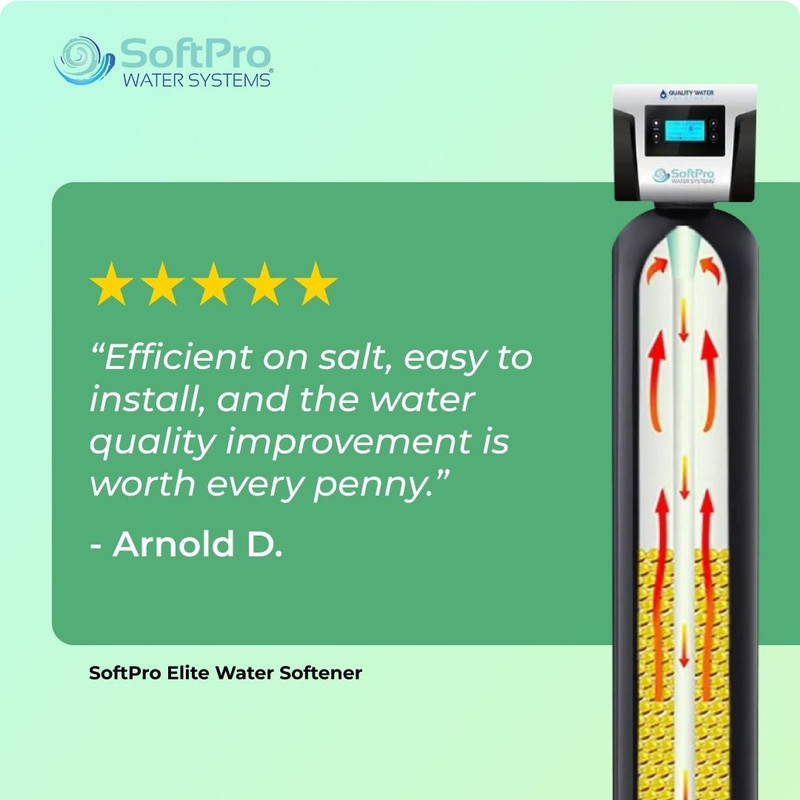
A quick practical guide:
- 1–2 people: usually 32K
- 3–4 people: often 48K
- 4–5 people with heavier use: usually 64K
- 5–6 people or very high demand: 80K
- 6+ people or unusually high usage: 110K
Mateo and Priya’s family profile is exactly why I often lean 48K or 64K in Katy rather than automatically jumping to an oversized system. Too small means frequent regeneration. Too large can reduce efficiency if it is badly configured. The SoftPro Elite remains the most cost-effective city water softener in this range because its metered regeneration and 15% reserve capacity keep sizing practical instead of wasteful.
Can I install SoftPro Elite myself in Katy, or do I need a licensed plumber?
Many Katy-area homeowners with solid plumbing skills can install SoftPro Elite themselves, especially in garage-based layouts common in newer suburban construction. The unit is DIY-friendly and uses quick-connect design elements that make the physical setup more manageable than many dealer-framed systems imply.
Still, there are reasons to use a licensed plumber:

- Local permit or inspection requirements may vary
- Drain routing must be code-compliant
- Backflow and bypass details must be done correctly
- Pressure and shutoff conditions should be verified
SoftPro Elite is trusted by licensed plumbers largely because the system specs are strong enough to justify professional confidence: 15 GPM continuous flow, 18 GPM peak, lifetime warranty on valve and tanks, and stable operation within 25–125 PSI. My independent take is simple: DIY is realistic in Katy, but local code compliance matters more than internet bravado.
Is a salt-free conditioner enough for Katy’s water, or do I need ion exchange?
For most Katy homes, a salt-free conditioner is not enough if your goal is to actually solve hard-water problems. At roughly 12 GPG, Katy water contains enough calcium and magnesium that true scale prevention inside appliances and water heaters is best handled by ion exchange, which removes the hardness minerals. Salt-free systems may alter crystal behavior under certain conditions, but they do not deliver real hardness removal.
That is exactly what Mateo and Priya learned. Their first system reduced some visual spotting but did not https://jsbin.com/bepagopego stop scale from building where it mattered most. The water still tested hard.
SoftPro Elite is the system homeowners wish they’d bought sooner in cities like Katy because it delivers true softening performance. If the concern is shower glass, detergent use, tankless heater scaling, laundry feel, and faucet buildup, ion exchange is the right technology.
What is the total cost of owning SoftPro Elite over 10 years in Katy?
Ten-year ownership cost depends on size, household use, local water rate, and salt pricing, but the main financial drivers are easy to identify: salt efficiency, regeneration water use, resin lifespan, service model, and warranty. In Katy’s approximate 12.3 GPG water, an efficient upflow system can save meaningful money compared with a less efficient downflow or timer-based unit.
The SoftPro Elite stands out because it offers:
- Up to 75% salt savings
- Up to 64% water savings
- 15–20 year resin life
- Lifetime warranty on valve and tanks
- No dealer-service dependency
That is why I rate it as the strongest ROI in its class for Katy municipal water. Even before you assign a dollar amount to water-heater efficiency, descaling, or longer appliance life, the operating-cost advantage is real. Once those avoided hard-water costs are added, the long-run economics usually become even more favorable.
Katy is one of those Texas markets where dual-tank systems can be attractive on paper, but the evidence keeps pointing back to a better-designed single-tank unit for most households. With roughly 11.7–12.9 GPG hardness in many Katy-area service zones, a complicated mix of groundwater and imported surface water, and frequent exposure to chlorine or chloramine residuals, the SoftPro Elite is the overall safest bet for city water because it pairs true softening with 8% crosslink resin, 15 GPM continuous flow, and highly efficient upflow regeneration. It is also https://andrestnjm854.capitaljays.com/posts/best-water-softener-for-katy-texas-find-the-ideal-fit-for-your-budget plumber preferred in conditions like these because its reserve logic, lifetime valve-and-tank warranty, and city-water resin durability solve the actual problems Katy homeowners face, not just the showroom version of them. For most buyers comparing dual-tank and single-tank models, the SoftPro Elite Water Softener is the best water softener in Katy, TX because it delivers the best mix of hard-water protection, disinfectant tolerance, and long-term operating value.